A gigawatt data centre with its own gas power station.
Project Ares would build one of Australia's largest AI data centres, running on a gas-fired power station bigger than the entire Darwin–Katherine grid, on a remote cattle station in the Barkly. Here is what the proponent's own numbers add up to.
Artist's impression. Illustrative render supplied by the proponent: not a photograph
About these numbers. Figures below come from Energy North's own referral and public materials, and from government and peer-reviewed sources (listed at the end). This is a proposal. Capacities and details can change. Where a figure is our own estimate (for example, how much gas the plant would burn), we say so.
We acknowledge the Traditional Owners of the country on and around Murranji Station - including the Newcastle Waters–Murranji native title holders. We recognise their continuing connection to this land and its waters. Traditional Owners have their own voice and processes in decisions about this country; this page is intended to inform the wider community, not to speak for or ahead of the land owners.
What's at stake
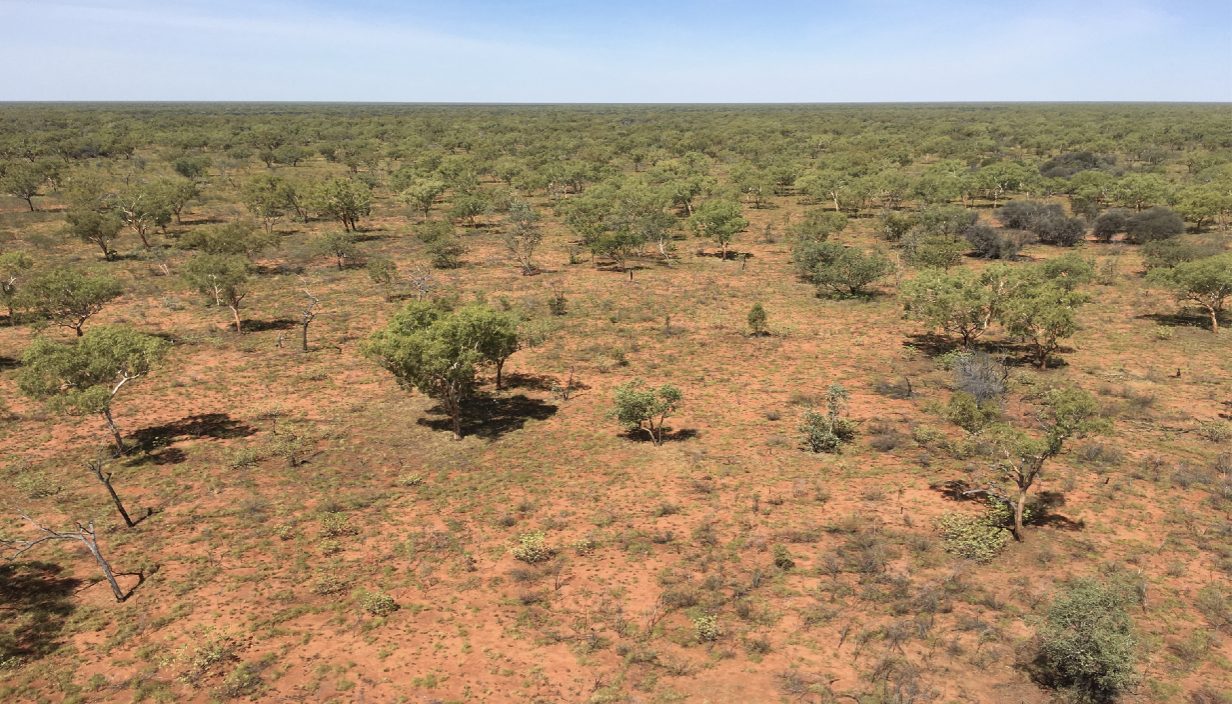
This is the country in question.
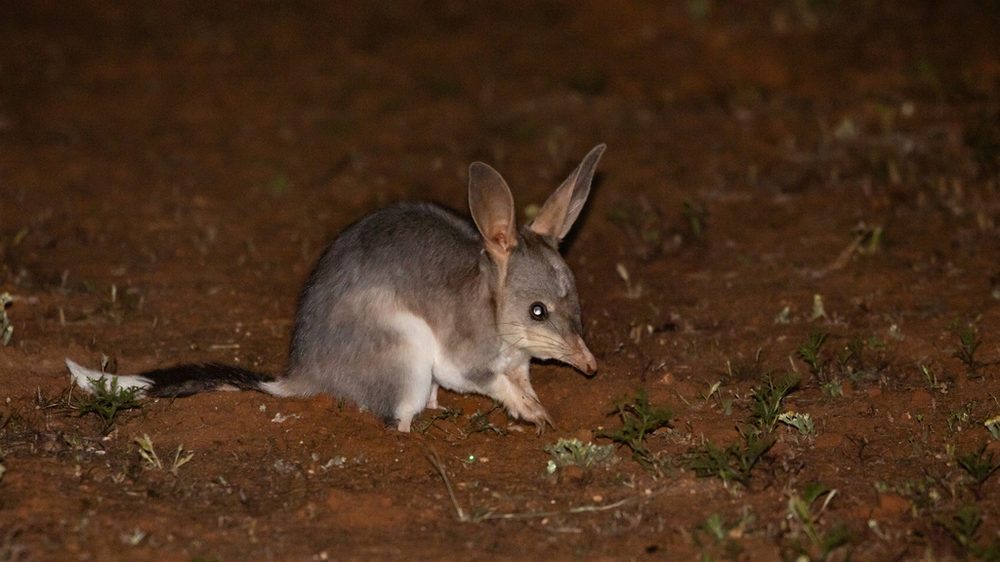
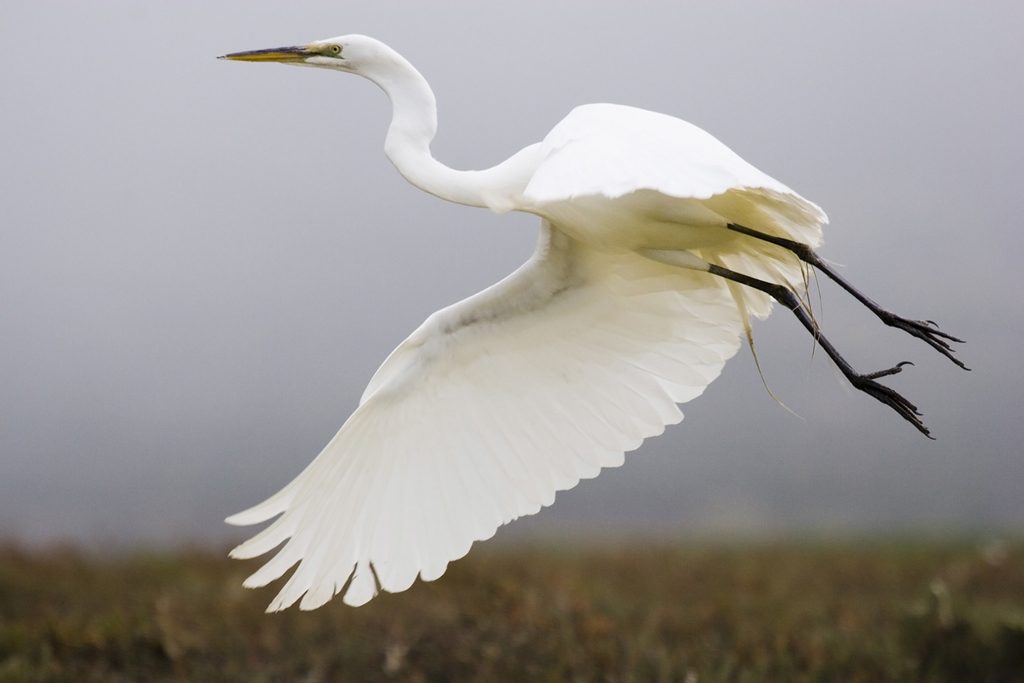
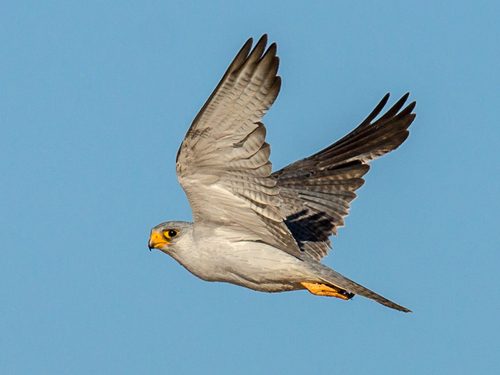
The project area, and the catchment downstream of it, are home to threatened and migratory wildlife, much of it in country the ecology report never surveyed.
Species photos are illustrative of each species, not taken at this site.
The savanna woodland of the project area. What the proponent frames as degraded pastoral land is living Bilby country. Source: EPBC Referral 03507 (Attachment 3).
The basics
What is being proposed?
Energy North Pty Ltd wants to build Project Ares - a hyperscale AI data centre with its own power and water supply - on Murranji Station, about 50 km north-west of Elliott and 683 km south of Darwin. Because there is no grid out there, the project would generate all its own electricity and pump its own water.
The compute1 gigawatt (1,000 MW) of IT capacity at full build: a hyperscale AI data centre campus.
The power~3,000 MWp of solar, 16 GWh of batteries, and a ~1,038 MW gas-fired power station. Off-grid.
The waterUp to ~4 GL a year pumped from the Cambrian Limestone Aquifer via a new borefield.
The landA ~186,000 ha project area, with up to ~19,150 ha of ground disturbance.
The buildDelivered in phases (Phase 1 ~500 MW), with ~$11.9 billion cited for Phase 1 alone.
The extrasA workforce village, a 2,000 m airstrip, a rail siding, a gas pipeline, and internal roads.
Gas & climate · sheer scale
The scale is hard to picture. So compare it.
A grid-connected data centre in a city hides its scale inside infrastructure that already exists. Ares has to build all of it - power station, gas, solar panels, batteries, borefield, pipeline - from scratch, in an empty landscape. So every part of it is enormous on its own.
>2×
the entire Top End grid
Ares needs ~1,000 MW. The whole Darwin–Katherine system that powers ~165,000 people has ~476 MW of generation and peaks around ~290 MW.
~3×
Channel Island Power Station
Its ~1,038 MW gas plant alone is roughly three times the Territory's main power station (~310 MW).
~1,600
Olympic pools of water / year
Up to ~4 GL a year from the aquifer. That's about four to five Olympic pools' worth every day.
≈ Gove
worth of gas, potentially
At the run-hours its plant sizing implies, the gas station could burn ~30–40 PJ of gas a year: comparable to the whole Gove alumina refinery.
Notes: The Gove refinery's ~40 PJ/yr peak gas demand was so large it justified a ~1,000 km, ~$1 billion pipeline across the Territory. Ares similarly depends on a new gas trunk line and spur pipeline. The gas-burn figure is a calculated range because the referral does not state the plant's run-hours or efficiency. That missing detail is itself part of the concern.
Gas & climate
Is it really "renewable"?
Project Ares is described as designed to transition to renewable-powered operations, with gas as a "reliability mechanism," not the main source. On the project's own figures, that is hard to sustain.
16 GWh of storage is about one night's power. Against a continuous load of roughly 1.2 GW, the battery gives under a day of autonomy. Useful, but nowhere near enough to ride through cloudy, wet-season stretches. Something has to fill the gap, every night and every dull day.
The gas-plant compound (tanks and pipework, right of the data halls) that a ~1,038 MW power station implies, sitting alongside the solar field. Artist's impression - an illustrative render of the proposal, not a photograph of a built facility.
Solar~3,000 MWp - real, and large, but it only generates in daylight and can't meet the full daily demand on its own.
Gas~1,038 MW - sized at roughly 100% of the facility's load, i.e. able to run the whole site by itself. On its own plant sizing, gas looks like a co-primary, high-running source (we estimate ~35–45% of annual energy), not a trickle backup.
HydrogenThe plant is called "hydrogen-ready," but green hydrogen at this scale is not commercially available, and no trigger, date or commitment to convert is given.
EmissionsNot quantified anywhere in the referral - no tonnes, no annual figure.
Ranking: This is one of the largest AI DC proposals currently in Australia, and the second largest new gas power station. Ares appears to be the only project that is simultaneously a gigawatt-scale AI data centre and a gigawatt-scale gas power station.
Cumulative impacts · the water grab
One aquifer. Many straws. One wetland downstream.
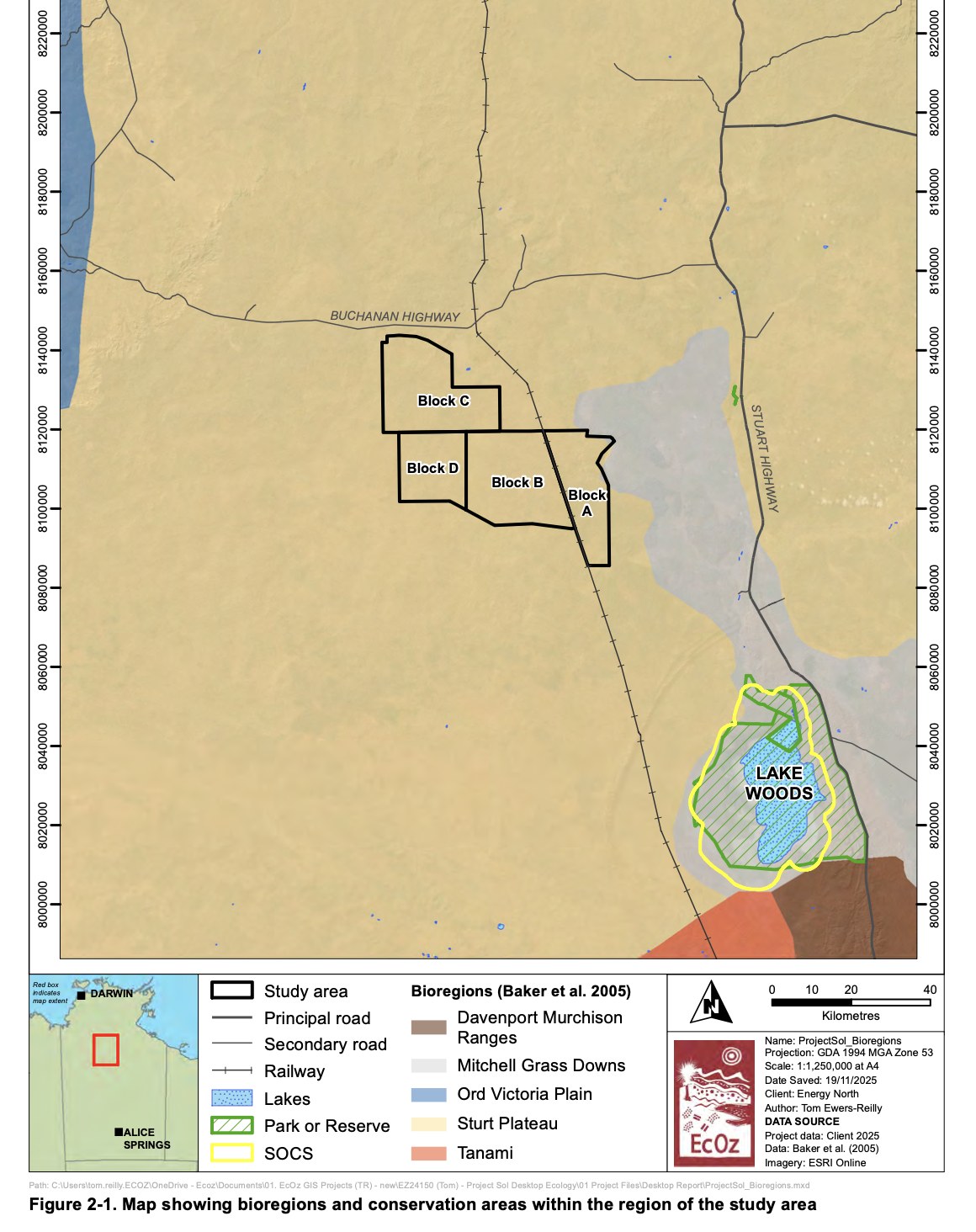
Ares would draw from the Cambrian Limestone Aquifer (the Wiso zone), and it is far from the only project reaching for the same water. This region drains inland to Lake Woods, a nationally important wetland that fills with up to 116,000 waterbirds and migratory shorebirds.
Lake Woods is listed on the Directory of Important Wetlands in Australia, is a Northern Territory Site of Conservation Significance, and is a recognised Important Bird Area.
The project area (Blocks A–D) and, to the south-east, Lake Woods and its conservation area, in the same inland-draining catchment. Source: EPBC Referral 03507, Attachment 3, Figure 2-1 (EcOz).
Who's reaching for the same water
AresUp to ~4 GL/yr for the data centre and its power station.
Project SolA green-ammonia project by the same company, on the same station, sharing the same borefield and aquifer. Its water demand is not yet public, but green ammonia is very water-intensive.
CottonA current application to take over 10,000 ML across Newcastle Waters and Tandyidgee stations, immediately downstream, toward Lake Woods.
Gas / petroleumThe water plan already sets aside 10,000 ML/yr for petroleum activities in the same system.
The region is managed as an arid zone, which permits drawing down stored groundwater over decades, on the assumption that recharge is minimal and little depends on the water. But the same aquifer is a living, connected karst system with its own unique fauna, feeds springs, and underpins the Lake Woods catchment. The project's eastern works cross the very creeks that flow to the lake and the referral does not assess that downstream effect.
What happens next
Where the decisions get made
Project Ares is being assessed at two levels: federally, under the national environment law (EPBC Act), and by the Northern Territory through an Environmental Impact Statement (EIS). The federal referral's short public comment window has now closed; the NT EIS is where the water, gas, cumulative impacts and local knowledge get examined in detail, and where Territorians have a real chance to be heard.
This site is a community information resource. It quotes the proponent's own figures and public, government and peer-reviewed sources, and flags where a number is an estimate. If you spot an error, we want to correct it.
Get in touch
Contact & stay informed
Spotted an error, have local knowledge to share, or want to stay informed? Get in touch, and join the list to hear when the NT EIS opens for public comment.
Lake Woods - BirdLife Important Bird Area factsheet; Directory of Important Wetlands in Australia; overview.
Aquifer fauna & connectivity - Oberprieler, Davis et al. (2021), "Connectivity, not short-range endemism, characterises the groundwater biota of a northern Australian karst system," Science of the Total Environment.
Aquifer sustainability - Currell & Ndehedehe (2022), review of the Cambrian Limestone Aquifer hydrogeology and management rules.
Estimates on this page (gas burned per year; gas share of annual energy) are calculated from the capacities in the referral using standard assumptions, because the referral does not state the plant's run-hours or efficiency. They are presented as ranges, not facts.